I selected this artifact because it was originally using a MongoDB database and I want to give the option to switch to a MySQL database. To do this work, it requires knowledge of the MySQL language. It also requires creating algorithms and structures that work with this structured database. The artifact was improved by creating a structured table with appropriate datatypes (VARCHAR, DECIMAL, UNSIGNED INT) and ACID compliance. ACID stands for Atomicity (all or nothing), Consistency, Isolation, and Durability which is great for companies that require a great deal of accuracy and care with their data. MongoDB uses a B-Tree structure and MySQL uses a B+Tree structure (Kagoshima, 2025). The speeds in Big O notation are similar for each database, O(log n), for most operations (Kagoshima, 2025). Optimization of accuracy is achieved with the MySQL database. However, using the MongoDB database gives the opportunity for sharding, or horizontal scaling. MySQL, typically uses vertical scaling.
Course Outcomes Met
I have met all outcomes with this enhancement. I have included significant comments and updates to the ReadMe file for communication and collaboration, which meets the first two outcomes. I discussed the advantages and disadvantages of switching from MongoDB to MySQL. I discussed the trade-offs and provided computing solutions for the alternatives available. I created test files to demonstrate the coding solutions to deliver value and meet industry-specific goals. I created role-based access with the MySQL database and kept security in mind. I also defined the datatypes in the table, enhancing security.
Challenges and Reflection
The first thing I had to do was to get the csv file into a MySQL database. I created a database and a table. I needed to define the datatypes for the columns of the table. I created a file that imported pandas and it counted the datatypes for me. I converted those datatypes to ones that are specific to MySQL and entered them using the command prompt. I also created a user and specified the user’s role for enhanced security. I didn’t want to use the root, which has all access, so I limited the access for data integrity and protection. Next, I created a file to test the database and specific queries used for the web application. One of the challenges was in trying to gauge the number of characters (memory space) that would be required for each element in the table. The nice thing about MySQL, however, is that the age range was easy to implement. The biggest challenge was that loading local data was disabled, and I had to set the Global local_infile variable to 1, temporarily, to download the csv file and then change it back to 0 afterwards. For security purposes, it should be changed back to 0.
Click to Download Enhancement Two Files
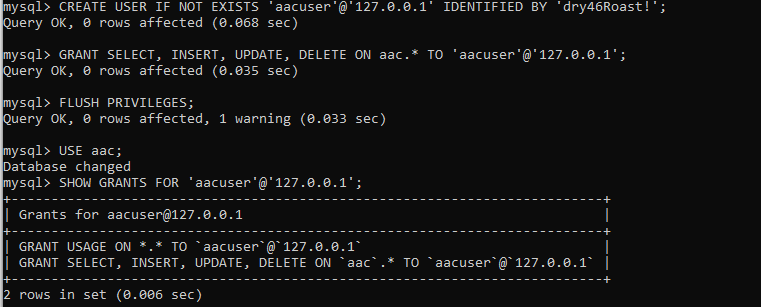
Figure 1 shows user creation and role-based privileges being defined.
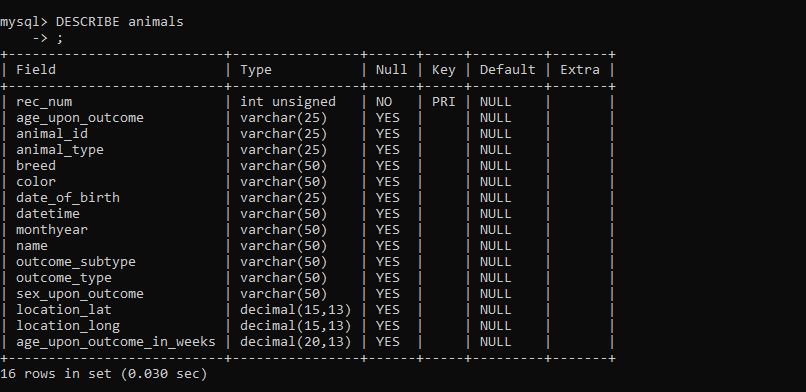
Figure 2 shows the MySQL table that was designed with the specific datatypes and memory allocation.